Front Pix
16 Killed, 35 Injured In Easter-Day Kaduna Blasts

A car bomb exploded in Kaduna state, North West Nigeria on Easter Sunday, killing several people, after security officers stopped the driver from approaching a church, witnesses and emergency services said.
Anxiety over safety of lives and property during the Easter celebrations were further aggravated as a bomb was exploded near a church in Kaduna State, North West Nigeria on Easter Sunday, killing 16 and leaving 35 people injured.
The death toll, according to The Tide source in Kaduna, had risen to 16 while 35 others were seriously wounded.
“A suicide bomber in a vehicle was moving towards the ECWA Church and the All Nations Christian Assembly,” said Tony Udo, a Kaduna resident.
“Security agents accosted and repelled him. While he was driving away, the bomb went off at Junction Road, near the Stadium roundabout, killing the bomber and some commercial motorcyclists,” Udo newsmen
“The blast from the bomb also shattered the windows of the church, some nearby houses and vehicles parked nearby. The area has been condoned off by security agents,” Udo added.
Meanwhile, security across the largely Muslim north was beefed up before the Christian Easter holiday because of fears of a repeat of attacks by the Islamist sect Boko Haram that killed dozens on Christmas Day last year.
One of the sect’s Christmas Day bomb attacks in the North killed at least 37 people and wounded more than 50 at a church.
Boko Haram has killed hundreds this year in bomb and gun attacks that mostly target churches, police, the military and the government.
The sect says it wants its imprisoned members released and Sharia, Islamic law, applied throughout Nigeria, Africa’s most populous nation.
In the remote northeast town of Maiduguri, Boko Haram’s homeland, the military outnumbered the public on some streets yesterday.
An eye witness account said the suicide bomber after security officers stopped the driver from approaching a church, and just shortly after as he was moving away from the church, the bomb exploded.
Reacting to the Easter Day bomb blast, the Deputy President of Senate, Senator Ike Ekweremadu condemned in strong terms the Easter suicide bomb attack leading to loss of lives and many other casualties in Kaduna.
Senator Ekweremadu who described the act of terrorism as “mean, distasteful, and out of tune with the nation’s cultural and religious values”, said the incessant bomb attacks were in discordance with the dreams of the founding fathers of Nigeria.
“Our fathers will surely turn in their graves over these bombings and senseless waste of highly precious human lives and property by enemies of the nation, but we as a people must unite in courage and solidarity to fight those behind these acts even as we must never accept them as normal because it is not in our character, cultural or religious values to waste lives”, Ekweremadu said.
The Deputy Senate President in a statement signed by his Special Adviser on Media Affairs, Uche Anichukwu called on religious, traditional and political leaders to prevail on their subjects to embrace peace, reconciliation, and unity, while calling on the nation to be vigilant and expose all suspicious activities by anybody whether highly or lowly placed”.
Ekweremmadu while expressing hope that the nation would overcome the present challenges in no distant future, condoled with the victims of the Kaduna bomb blast, praying God to grant the deceased peaceful repose and the injured quick recovery.
”It is also my earnest prayer that the power of resurrection of this Easter washes away the sorrows of all those who have lost their beloved ones and supply them with the inner strength to bear the irreparable losses”, he added.
The federal and state governments had earlier beefed up security across the largely Muslim north before the Christian Easter holidays because of fears of a repeat of attacks by the Islamist sect Boko Haram that claimed over forty lives and got over fifty injured on Christmas Day last year.
The sect, employing suicide bombers and assault-rifle shootouts, has attacked both Christians and Muslims, as well as the United Nations’ headquarters in Nigeria.
The sect has rejected efforts to begin indirect peace talks with Nigeria’s government. Its demands include the introduction of strict Sharia law across the country, even in Christian areas, and the release of all imprisoned followers.
The blast had also come on the heels of the United Kingdom and the United States warning of their citizens living in the oil-rich nation that violence was likely over the Easter holiday.
Kaduna, on Nigeria’s dividing line between its largely Christian south and Muslim north, was at the heart of post election violence in April 2011. Mobs armed with machetes and poison-tipped arrows took over streets of Kaduna and the state’s rural countryside after election officials declared President Goodluck Jonathan the winner. Followers of his main opponent, former military ruler Muhammadu Buhari, a Muslim, quickly alleged the vote had been rigged, though observers largely declared the vote fair.
Across the nation, at least 800 people died in that rioting, Human Rights Watch said. In the time since the bomb blasts, heavily armed soldiers had remained on guard on roadways throughout Kaduna. In December, an explosion at an auto parts market in Kaduna killed at least seven people.
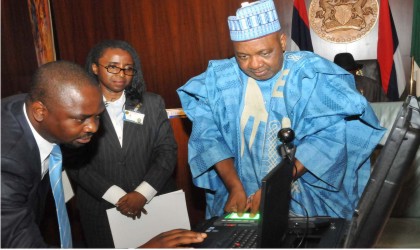
Vice President Namadi Sambo (right),being captured by Tax Data Capturing Machine to commence the National Tax Identification Number Policy in Abuja last Thursday. With him is former Chairman, Federal Inland Revenue Service, Mrs Ifueko Omoigui-Okauru.