
Issues
Climate Change, N’Delta And The World At Denmark

Being the concluding part of this article fist published on Monday December 7, 2009
Crude Oil Price And National Economy 95 per cent of our foreign exchange earnings comes from crude oil – a commodity we have no influence over the pricing, production quota, and unfortunately also mismanage the revenue accruing to us from it. We have always been victims of the speculative frenzy associated the gyration in crude oil pricing.
Our budget is hinged on price of crude oil. By mid 2008 oil prices were hovering around (US)$150 for a barrel. The talk everywhere for all in the line-up is excess crude account and the sharing formular. The big question is: Why should excess revenue from crude be shared in a country with the poorest power supply, road networks in disrepair, no start-up fund or sources of soft agricultural and industrial loans? Further, how do we make up when revenue from oil falls below the budget benchmark of (US)46 per barrel. Currently, any revenues received above the benchmark budget price is tagged ‘excess crude account’ and it is shared amongst the local, state and federal govemment. Many still consider this practice unhealthy amidst several infrastructural decay.
Technical And Vocational Education
The value of technical and vocational education and training need to be given the attention it deserves because it forms part of the bedrock for the nation’s industrial take off. It is an established fact that universities and tertiary institutions worldwide do not produce trained manpower, rather trainable manpower. With this understanding, both parents, the three tiers of government and organisations must encourage school leavers to undertake additional training (apprenticeship) to acquire specific skills in addition to those taught at school. This prepares them to be employable, entrepreneurial and capable of fitting in, in a wide variety of circumstances. This has been a rewarding trend in developing nations.
Agriculture
No scientific invention so far has reduced the importance of agriculture. It is generally believed that a nation that cannot feed its citizens remains largely underdeveloped. Interestingly, Nigeria has all the resources to feed her citizens, but with the discovery of oil in the 70s, agriculture was disemphasised resulting in Nigeria being an importer of basic foods including palm oil. The immediate past administration of Olusegun Obasanjo encouraged a retum to the farms by introducing some reforms and incentives including making loans available through the Nigerian Agricultural and Rural Development Bank and a few other designated banks. In the Seven Points Agenda of the Yar Adua administration agriculture also occupies a conspicuous position, and this is commendable. It is also interesting to note that some state govemments have gone ahead to guarantee agricultural loans thereby removing the hurdle posed by inability of farmers to provide security for loans. This is commendable and should be emulated.
The challenge in this sector however is the wide information gap between govemment policies and the benefiting public. Most of these policies are unknown to the public and the farmers. There is also a wide chasm between the researchers and the real farmers. As a result, major discoveries remain as academic papers in the shelves and libraries in our tertiary institutions and other agricultural research institutions. The consequence is that the farmers have sustained the old approaches to planting. They are not motivated to experiment with anything unfamiliar. This challenge can be managed when the community leaders, elected councillors and the researchers work in a synergy.
Attitudinal Change
A major challenge facing Nigerian business community and the public service is the people’s attitude to work. Most Nigerians are entrepreneurial by nature, but this is not manifest in the public service. This is perhaps why the Information Minister is campaigning for REBRANDING NIGERIA. This is still largely misunderstood, we certainly need a change of attitude in the areas of honesty, commitment to work, punctuality, and providing quality service. We must understand that service quality is a distinguishing factor between survival and failure in a service economy.
Conclusion
While we are recipients of negative effects of intemational politics and economic policies, the bulk of our problem is largely internal. That is to say that anyone of us could fail, not necessarily because of the global economic meltdown, rather due to deliberate neglect to understand the chain of unfortunate events and respond quickly.
For our organisations, the bureaucratic model appears hopelessly out of place. According to Peter Drucker: “we are evolving past the monolithic, self perpetuating, steadfastly bureaucratic organisation.” What we need today is a flat, nimble and responsive organisation that can respond to the rapidly changing paradigm, and this demands a radical shift.
In the present pace of change, ignorance can be devastating. It is therefore a necessity that we continuously make conscious efforts to update our knowledge and make informed and appropriate decisions. This is where the Institute of Corporate Administration comes in. With about 50 seminars, in-plants workshops, public lectures, and publications, we have positioned ourselves as providers of ongoing source of high performance training.



This is an open letter to the Minister of the Federal Capital Territory, Chief Nyesom Wike.
Your Excellency,
Sir, ordinarily, I would not be writing an open letter to you, but like a wise man once said, “Silence would be Treason.” So I prefer to stay alive than face the consequences of silence in the face of crime. With each passing day, and as the socio-political tides continue to turn, it has become more pertinent that more people speak up in a concerted MANNER to prevent the death of our party, the Peoples Democratic Party (PDP), as we appear to be, in the words of W. B. Yeats, “turning and turning in the widening gyre” heading for an end where the falcon will no longer hear the falconer
It is unfortunate that since losing control of the Federal Government, with the loss of President Goodluck Jonathan at the poll in 2015, our party, the Peoples Democratic Party (PDP), has continued on a downward spiral. It is much more painful, that where it is expected that leaders within the party should rise to the challenge and put an end to this decline of our great party, some have instead taken up roles as its undertaker.
It will be hypocritical to claim aloofness to what I believe is your grouse with the PDP and I am not a hypocrite. It will be uncharitable on my part to discountenance the role you have played in strengthening the PDP from 2015 up until the last Presidential primaries of the party. It is my belief that your grouse against certain members of the party who you perceived worked against the party and abandoned it in 2015 and then came around much later to take control of the party, is justified. Also know that your decision to remain in the Party and stifle its progress on the other hand, as a sort of payback, stands condemned. For a man of your pedigree and stature, it is a dishonorable act, highly dishonorable and stands as testimony against all you claim to stand for.
At least, it can be argued that those who you hold this grudge against, abandoned the party completely and did not sit back while actively working to destroy it from within. But what then can be the argument on your own part, seeing that those you are currently working with against your party are the same people who set in motion, and executed surgically, the plans that not only ended our Party’s leadership at the centre, but ended up dislodging the first Niger Deltan to occupy Aso Rock as Commander in Chief of the Armed Forces. Is this not akin to “cutting off one’s nose to spite one’s face?” That will be worse than folly. Let us not throw away the baby with the bath water because we do not like the soap used in bathing the baby. It will be a grave mistake.
Honourable Minister, sir, it is rather unfortunate that of all people, you have also decided to play the role of an undertaker not only for our party, but for our dear Rivers State.
I will like to take you down memory lane a little. Let me remind you of your emergence as Guber candidate of the PDP in Rivers State, against all fairness and justice in 2014. You will remember that despite the reality being that you as an Ikwerre man was poised to replace a fellow Ikwerre man in Governor Chibuike Rotimi Amaechi in our multiethnic state, Rivers people overwhelmingly stood by you and pushed for your emergence as Executive Governor of Rivers State in 2015. I dare say that your popularity in the entire Niger Delta region was at an all-time high at this point.
I want you to understand why you were loved across board leading to your eventual emergence as Governor of Rivers State in 2015; it was because when it looked like all were against the second term ambitions of the first Niger Delta man to emerge as President of Nigeria, you became not just a pillar but a beacon of resistance by standing for Goodluck Jonathan. Rivers people, as grateful and rewarding as they can be, paid you back by ensuring your electoral victory against the incumbent All Progressives Congress (APC) led by your predecessor. On your emergence, where there were second term Governors in the region, you, a first term Governor, was seen by the people as not just the leader of the PDP, but the leader of the entire Niger Delta region. You earned it, and no one could dispute it.
In 2019, when your re-election bid was being challenged ferociously, Rivers people once again stood solidly behind you. Many were killed in the process of defending your votes. Do you remember Dr. Ferry Gberegbe that was shot and killed while trying to protect your votes in Khana Local Government Area? There are many more unnamed and unrecognised sons and daughters of Rivers State who sacrificed their lives so that you could emerge as a second term Governor of Rivers State.
In 2022/23, Honourable Minister, you oversaw a party primary across board that saw some candidates imprisoned and internal party democracy jettisoned for your wishes, leading to the emergence of flag bearers of our party all singlehandedly picked by you. You have on more than one occasion publicly stated that you paid for all their forms. Even those shortchanged in this process licked their wounds and continued to play their roles as party members to ensure the success of the party at all levels. In what will go down as one of the most keenly contested elections in recent Rivers history, with formidable candidates like Senator Magnus Abe of the Social Democratic Party (SDP), Mr Tonye Cole of the All Progressives Congress (APC), and the vibrant youth driven Labour Party (LP), PDP emerged victorious across board except for Phalga Constituency 1 that was lost to the Labour Party. (Not that you did not loose in some other LGA’s but let’s stick to the official figures declared by INEC).
It begs the question, why then do you want to burn down Rivers State, when everyone who now holds political office emerged through a process designed and endorsed by you? Is it that you do not care about Rivers people and you are all about yourself? If so, I am forced to believe that those around you are not telling you the truth. The truth being that in a state where your words were law; where houses and businesses could be demolished or closed down without any recourse to legalities, where Executive Orders could be deployed to stifle the opposition, that your popularity is now at an all-time low. Probably because they are afraid of you, or of losing the benefits they gain from you, they fail to tell you that what you might perceive as a battle against your successor, has slowly but gradually degenerating into a battle against Rivers State and Rivers people. You know, there is a popular saying that, a man can cook for the community and the community will finish the food, but when a community decides to cook for one man, the reverse is the case.
LEAVE FUBARA ALONE
You have gone on and on about being betrayed by Governor Siminalayi Fubara. You point fingers forgetting that some of those same fingers quick to spot betrayals point straight back at you. It is not Governor Fubara that has betrayed the PDP by working against it in the just concluded General Election, and working with the opposition at the State and Federal level to destabilise the party. It is you, Honourable Minister. It is not Governor Fubara that betrayed Rivers people by instigating a political crisis with propensity to escalate ethnic tensions in Rivers State. It is you Honourable Minister. It is not Governor Fubara that has declared himself God over all in Rivers State and has no qualms with burning the state to the ground to prove a point. It is you Honourable Minister. It is you Honourable Minister who told the world that the APC was a cancer and you can never support a cancerous party. It is you Honourable Minister who ended up facilitating the emergence of the same “cancerous” APC that has accelerated the economic decline of this country and further impoverished our people with no remorse. All so you can be a Minister of the Federal Capital Territory? The lack of self awareness is gobsmacking.
Some days back I came across a video where you talked about death and how you do not cry when you hear about the death of some people because you have no idea what might have caused it considering many a politician swear “over dead bodies” and still go back on their words. Those words made me think, and I could see the reason behind them. You see, in chosing to be God in the affairs of Rivers people, you have closed your eyes and ears to reason; you see nothing and hear nothing that can cause you to rethink on the path you have chosen. In your quest to “show Fubara” you have unwittingly united a vast majority of Rivers people behind him, so much that even those who despised him because of you, now like or love him, because of you too. In your scheming, I will advise you not to forget that “the voice of the people is the voice of God”.
Note that the war which you have or are waging against Governor Fubara, has gone beyond being merely political as you might see in your minds eye. It is now one that, fortunately for some and unfortunately for others, has evolved into a war against Rivers people. It is good to point out that no one has taken a stand against Rivers people and won. No one has gone against God and won. In your defiant characteristic manner, it will be unfortunate if you believe your own hubris and that of those around you on the possibility of you being the first to successfully go against Rivers people. It will be a needless gamble; one where if you win you create more enemies for yourself than you can withstand on your political journey, and if you lose, your legacy becomes an inglorious and irredeemable one in Rivers State, the Niger Delta, and Nigeria at large. For your sake as regards posterity, it is my greatest wish that you have a moment of sobriety and a deep reflection and introspection on this path you have chosen.
Honourable Minister, sir, what is left of your legacy is on the brink of being completely desecrated and relegated to the dustbin of our political history, and it will be a sad end to what I will say has been a wonderful political career that many can only dream of. The ball is in your court, and may God Almighty have mercy on us all and forgive us for our shortcomings.
Gabriel Baritulem Pidomson
Dr Pidomson is former Chief of Staff, Government House, Port Harcourt and former member, Rivers State House of Assembly.
In 2015, I made a conscious decision to invest my financial resources, my time, and energy into supporting Nyesom Wike’s gubernatorial campaign. I poured my heart and soul into ensuring Nyesom Wike emerged victorious even at the risk of my personal safety.
Again in 2019, I doubled down on my commitment. I invested a significant amount of money to procure campaign outfits for all twenty-three Local Governments Areas of Rivers State. I spared no expense in supplementing Wike’s election efforts in my own local government, and once again putting myself at great risk to safeguard the fairness and transparency of the electoral process.
However, despite my unwavering loyalty and sacrifices, I found myself abandoned and forgotten by Wike. Throughout his eight-year tenure, he failed to acknowledge my contributions or fulfill his promises and agreements. Even as a former Deputy Governor, Wike denied me my severance benefit.
My investment in Wike’s governorship was not just financial – it was a commitment of passion, dedication, and belief in a better future for Rivers State. Yet, his leadership style of dishonesty, greed, drunkenness and rash abuse of senior citizens brought me nothing but disappointment, misery and losses.
By the grace of God, today I speak not as a victim, but as a hero. I have accepted my losses, and I have moved on. And as I reflect on my experience, I cannot help but urge Wike to do the same and allow peace and development to reign in Rivers State.
Nyesom Wike, when you speak of investing in Governor Sim Fubara’s election, remember those like me who also invested in you. Remember the sacrifices I made, the risks I took, and the promises and agreements you left unfulfilled.
It is time for you, Wike, to let go of the past and allow Governor Sim Fubara the breathing space he needs to lead Rivers State forward. Allow him to focus on the challenges of good governance and the aspirations of the people. Spare him these unwarranted and ill-conceived political manoeuvrings founded on personal agenda and not for general good of Rivers State and her people.
I may have lost my investment on Wike, but I have not lost hope in the future of Rivers State. And together, we will continue to strive for a brighter tomorrow.
Long Live the Governor to Rivers State, Sir Siminialayi Fubara!
Long Live the Good People of Rivers State!!
Long Live the Federal Republic of Nigeria!!!
Engr Ikuru is former Deputy Governor of Rivers State.
Tele Ikuru
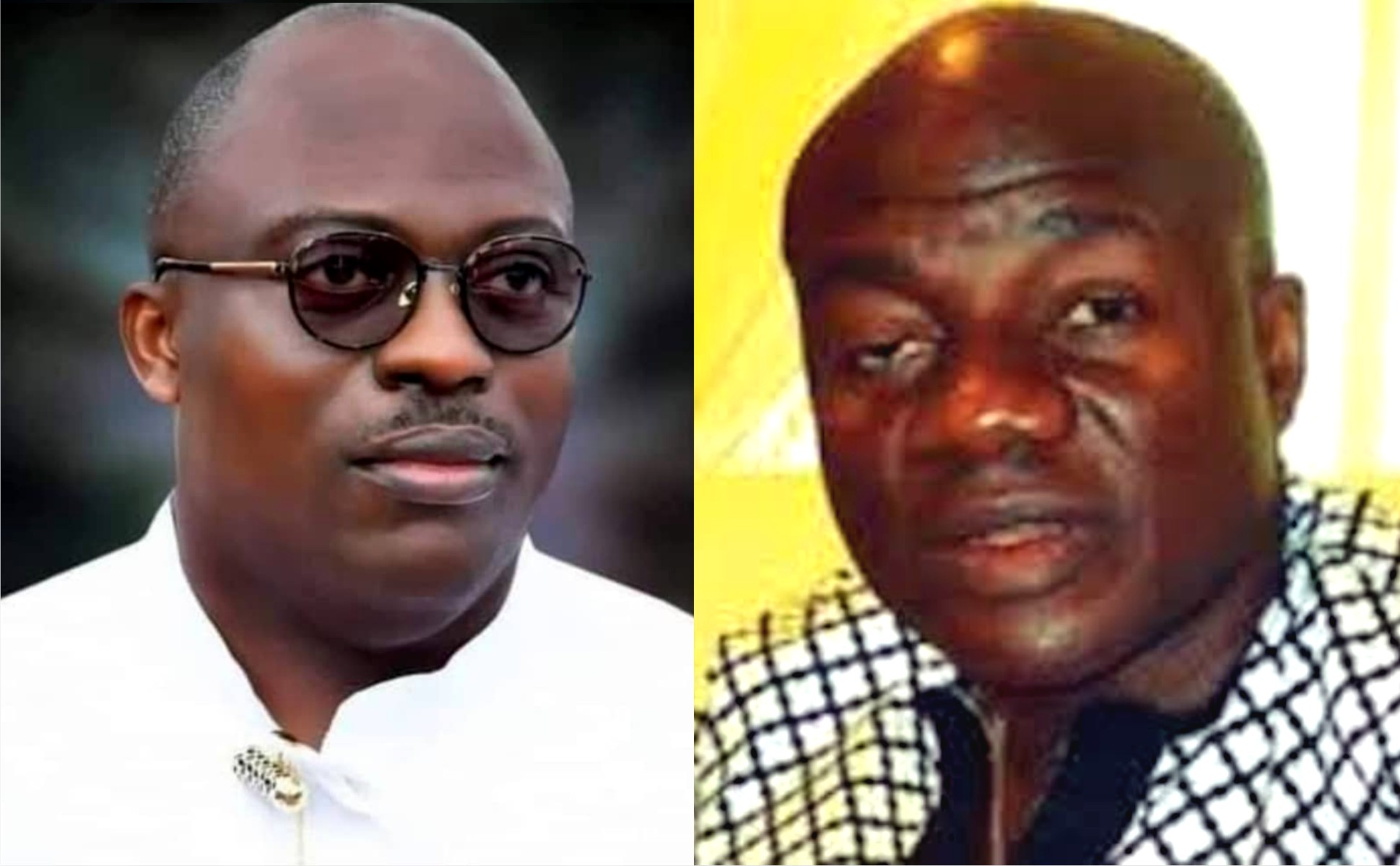
The man Tony Okocha, the devastated tattered ragtag remnant Rivers APC factional, but Caretaker, Chairman, is known for being notoriously a hireling willing to play in the mud just for the pay or settlement. To Rt Hon Chibuike Rotimi Amaechi, he did against Chief Nyesom Wike. To Senator Magnus Abe, he did against Rotimi Amaechi. To Chief Nyesom Wike, he did against Magnus Abe. Having maintained such unbefitting character trait, it is not surprising to see him at his demeaned best showing off his tainted skill of grandstanding and loquaciously struggling fruitlessly almost every day to castigate the popular Rivers people’s Governor with very glaring false, bogus and unsubstantiated claims such as:
1. That Governor Fubara is wasting state fund in the name of thanksgiving across 23 Local Government Areas.
2. That Governor Fubara has withheld Local Government funds.
3. That Governor Fubara runs the government without input from the State Executive Council.
4. That nothing is happening in the State with respect to governance.
To the above false claims of Tony Okocha, every reasonable, right thinking and well-meaning Rivers person would effortlessly puncture all as rascality and mendacity taken too far.
Apart from the fact that Governor Siminalayi Fubara had said he is not sponsoring the massive SIMplified Movement Thanksgiving events across the Local Government Areas of the State being organised by elated Rivers people who feel liberated from an era of overbearing and suppressive form of leadership in the State, Tony Okocha should be asked to prove his false claim with indisputable facts and figures. Until then, let Tony Okocha respect himself and learn to keep quiet as an elderly person who is saddled with such a responsible position as Rivers State Representative in the Niger Delta Development Commission (NDDC) Board. A position that places a huge responsibility on him to ensure that the core objectives of the commission are actualised in the State, by not only ensuring that Rivers State gets its fair share of its dues in terms of projects, programmes and activities, but by synergising with the state government on development matters concerning the state vis-a-vis the responsibilities of NDDC to the State. In summary, the SIMplified Movement is all about a happy and joyful people of Rivers State who have decided to stand and stick together to defend and uphold their common heritage and patrimony. It is a voluntary venture, not sponsored by the government.
To his claim that the Governor has withheld Local Government funds, Mr Tony Okocha should also be asked to prove that with facts and figures and explain why the Governor would do such. More so, what is Tony Okocha’s business, assuming, but not conceding, that a PDP Governor withholds money against PDP-led 23 Local Government authorities? Did Local Government workers across the state complain to Okocha, the meddlesome hireling, an acclaimed APC Caretaker Committee Chairman in Rivers State?
On his ignorant and false claim that the Governor runs the government without input from the state exco, Okocha, the busybody wannabe should explain how he was employed or engaged as the spokesperson of members of the Rivers State Executive Council. He should also tell us his source of information to that effect, if it is not just a proof that he is making himself known as a perpetually irredeemable hireling notoriously good for playing the spoiler’s role.
On Mr Okocha’s assertion, probably, borne out of lack of more convincing lies, that nothing is happening in the State with respect to governance, is sure a proof that the man is only acting a bad and an unsellable script to justify the reward of expected gratifying filthy lucre, which is the compelling reason for condescending so low and evilly so. How else is governance measured, if not by executing meaningful and impactful projects, giving hope, inspiring and putting smiles on the faces of the people with joy of fulfilment in their hearts, both civil servants and everyone living and doing business in the State? Is Okocha blind to see and deaf to hear of the good works of the Governor Fubara led Rivers State Government? Civil servants are happy, teachers are highly elated. Several projects are ongoing. Investors are trooping in. The health sector, education, agriculture, sports have been highly boosted under Governor Fubara-led administration. To Okocha, there’s no governance in the State because patronage of free money is not getting to him from the Governor but from other sources that are likely against the Governor.
Let Tony Okocha weep more. Rivers State is breathing fresh air already and is liberated.
Let Tony Okocha tell us how he has, so far, as Rivers State Representative in the Niger Delta Development Commission (NDDC), clearly effected development in the State through the NDDC, and why he lied that there was Cholera outbreak with deaths recorded in Soku in Akuku-Toru Local Government Area with the intent of raking in about ¦ N5billion for non-existent mitigation programmes?
Odike is Special Assistant to Rivers State Governor on Social/New Media .
Bernard C. Idike
-
Rivers19 hours ago
Rivers Police Uncovers Firearm Concealed In Loaf Of Bread
-

 Niger Delta15 hours ago
Pro-Chancellor Hands Over Okey Onuchuku Peace, Conflict Institute Building
-

 News16 hours ago
Fubara Reaffirms Commitment To Blue Economy, Private Sector Growth …Calls For Protection Of Marine Resources
-
Sports19 hours ago
Six Nigerians To Play For NBA Teams
-
Business19 hours ago
Gas Economy: Decade of Gas, Pi-CNG/ EV Deepen Media Engagement
-
Business20 hours ago
Navy Nabs 13 Black Sand Miners In Bayelsa –Impound Two Boats
-
 Business16 hours ago
IPMAN Raises Concern Over Delay In Chinese Refinery Deal …Predicts Lower Fuel Prices Through Competition
-
Business19 hours ago
Accountable Leadership, Urgent Reforms Will Stimulate Economic Growth — Osi